
Curriculum Improvements: Technical Skills, Original Artistic Voice, and Resilient Imagination
A Curriculum for Artists at Every Skill Level
At Chris Babcock Art Prep, we welcome beginners, intermediate students, and advanced artists. Students do not need to arrive with polished skills or an established portfolio. They simply need to be curious, willing to learn, and ready to participate.
Our curriculum has a twofold mission:
To teach students the technical skills and visual vocabulary they need to create meaningful, visually compelling artwork.
To cultivate courageous curiosity and resilient imagination—the confidence to explore, make mistakes, reflect, revise, and continue creating without destructive self-criticism.
Artist Statements: Discovering Deeper Meaning
Students will learn to write age-appropriate artist statements about selected artworks and projects.
An artist statement is not simply a description of a finished artwork. It is also a reflective tool that can bring an artist closer to the deeper meaning of what they have created.
By writing about their images, materials, colors, memories, emotions, and artistic decisions, students may begin to recognize connections and ideas they did not fully understand while making the work. Sometimes an artwork’s meaning is clear from the beginning. At other times, meaning emerges gradually through experimentation, reflection, and the creative process.
Students will learn to ask these kinds of questions
What inspired this artwork?
What idea, emotion, memory, or question was I exploring?
Why did I choose these particular images and materials?
Which elements of art are most important to this piece?
How do my choices of line, shape, form, color, texture, space, and value influence its mood or meaning?
What surprised me while I was working?
What challenges or mistakes changed the direction of the artwork?
What did I discover about the artwork—or about myself—while making it?
What questions do I want the viewer to continue considering?
An effective artist statement should open a door into the artwork without closing the door on the viewer’s imagination. It can reveal the artist’s intentions, influences, materials, questions, and creative choices while preserving space for personal interpretation.
Responding to Feedback with Confidence
Writing and discussing artist statements will also help students develop the language to speak about their creative choices with greater clarity and confidence.
When students receive criticism or constructive feedback, our goal is not to teach them to defend every decision or reject another person’s perspective. Instead, we teach them to:
Listen thoughtfully without immediately giving up on their ideas.
Ask questions when feedback is unclear.
Decide which observations may help the artwork grow.
Explain their intentions without becoming defensive.
Recognize that different viewers may interpret the same artwork differently.
Revise when revision strengthens the work.
Continue creating without allowing one person’s opinion to determine their worth or silence their imagination.
The goal is not to make students immune to criticism. It is to help them separate their personal worth from an evaluation of one artwork, remain curious about other perspectives, and make thoughtful decisions about their own creative direction.
Developing Lifelong Creative Habits
Through technical instruction, experimentation, reflection, artist statements, and supportive critique, we want students to develop habits they can carry into art and every other meaningful challenge they pursue:
The curiosity to ask questions and search for deeper meaning.
The courage to experiment, take creative risks, and express an original point of view.
The self-awareness to understand and explain their choices.
The discernment to recognize useful feedback without surrendering their artistic voice.
The resilience to learn from mistakes, revise their work, and keep going.
Our long-term goal is for students to be able to draw upon these qualities naturally and confidently whenever they encounter a creative challenge.
Responding to Insults and Bullying About Artwork
Students will learn the important difference between constructive criticism and cruelty.
Constructive criticism addresses the artwork respectfully and offers an observation, question, or suggestion that the artist may consider. Statements such as “Your artwork sucks,” “It’s ugly,” or “That’s stupid” are not constructive criticism. They are insults intended to embarrass, discourage, or hurt the artist.
An artist statement can help students remain connected to their ideas and understand why their work matters to them. However, students are never required to explain or defend their artwork to someone who is treating them disrespectfully.
If a student feels safe responding, they may calmly say:
“You do not have to like my artwork, but you may not speak to me that way.”
“That is an insult, not constructive feedback.”
“If you have a respectful question about my artwork, I will answer it.”
“I am proud that I tried something original.”
Students will also learn that courage does not mean remaining in an unsafe or humiliating situation. They may end the conversation, walk away, and seek help from a teacher, counselor, parent, or another trusted adult. They should not insult the other student in return or attempt to handle repeated bullying alone.
If the comments continue, become threatening, appear online, involve damage to the artwork, or cause the student to feel unsafe, the student should document what happened and report it to a trusted adult immediately.
Resilient imagination does not mean pretending that cruel words do not hurt. It means recognizing that another person’s insult is not a truthful measurement of the artwork—or of the artist—and finding the support and courage needed to continue creating.
The Seven Elements of Art
Students will learn how the seven elements of art can make an artwork visually compelling and help it express an idea, a feeling, or both.
Line and line variety create movement, energy, rhythm, direction, emphasis, and emotion. Students learn to vary the thickness, length, direction, texture, and character of their lines. Delicate, bold, curved, angular, broken, controlled, and energetic lines can each communicate something different.
Shape is a flat, two-dimensional area with height and width. Geometric and organic shapes can organize a composition, create patterns, represent objects, carry symbolic meaning, and guide the viewer’s attention.
Form has—or appears to have—height, width, and depth. Form gives an object volume, weight, structure, and a sense of three-dimensional presence. In drawing and painting, artists create the illusion of form through value, shading, and perspective.
Color establishes mood, creates emphasis, suggests temperature, unifies a composition, and communicates emotion. Relationships among colors can create harmony, contrast, energy, or tension.
Texture describes how something feels or appears as though it would feel. Actual and implied textures can make artwork more sensory, believable, expressive, inviting, or unexpected.
Space describes the areas within, around, between, and behind objects. Positive and negative space can create balance, focus, depth, distance, closeness, openness, isolation, or movement.
Value describes how light or dark a color or area appears. Changes in value create contrast, atmosphere, emphasis, depth, drama, and the illusion of three-dimensional form.
Students will learn these elements as practical tools—not as a checklist that must be included in every artwork. They will consider which elements best support the meaning, mood, and visual impact of each individual piece.
Narrative, Mystery, and Interpretation
Students will learn that artwork can contain both narrative and mystery. An artwork may communicate a recognizable story, capture a single moment, express an emotion, investigate an idea, or leave important questions unanswered.
Film is a time-based art form. A filmmaker guides the audience through an arranged sequence of images, sounds, actions, and pauses. Even when an art film is mysterious or ambiguous, the filmmaker controls the order and duration of the experience.
A painting, drawing, or sculpture is experienced differently. It presents images, forms, and materials within a visual or physical space. Viewers generally decide where to look first, what to examine next, and how long to remain with the work. A single artwork may suggest something that happened before or after the moment depicted, but the viewer is invited to imagine the missing parts.
Entertainment films often emphasize an accessible narrative and an engaging emotional experience. Art films may place greater emphasis on atmosphere, visual language, symbolism, experimentation, and ambiguity. These categories can overlap: an entertaining film can also be a profound work of art, and an art film can be deeply entertaining.
In the same way, visual artwork can communicate a strong idea without telling viewers exactly what they must see, feel, or believe. Mystery, ambiguity, contradiction, and surprise invite viewers to pause, wonder, and form their own relationships with the work.
An effective artist statement should open a door into the artwork without closing the door on the viewer’s imagination. It can reveal the artist’s intentions, influences, materials, questions, and creative choices while preserving space for personal interpretation.
To all our current and returning students and parents:
REVISED Studio Expectations, Behavior Consequences
At Chris Babcock Art Prep, every student deserves a peaceful, supportive studio where they can concentrate, learn challenging skills, make mistakes safely, and create their best artwork.
We understand that children sometimes need reminders and may occasionally arrive tired, distracted, or upset. However, when one student’s behavior repeatedly prevents the class from learning, we must intervene firmly to protect the experience of every artist in the studio.
Parents and guardians, please review these expectations with your child before every class. Children often need consistent reminders before respectful studio behavior becomes a natural habit—just like learning to say “please” and “thank you.”
Studio Expectations
Remain seated in your assigned seat unless a teacher gives you permission to get up.
Raise your hand when you have a question, need assistance, or would like permission to leave your seat.
Respect each student’s individual consultation time. Please wait patiently while the teacher is assisting another student. The teacher will help you as soon as they are available.
Do not run through the studio, shout, talk loudly, or distract other artists while they are concentrating.
You are not allowed to use any screen devices, including smartwatches, during class. If you are wearing a smartwatch, please remove it and put it in your backpack or in the box for screen devices at the door.
Consequences for Disruptive Behavior
If a student significantly disrupts the class again after receiving a formal warning, we will meet with their parent or guardian to discuss the behavior and create a clear plan for improvement. We want to give every student a reasonable opportunity to succeed while protecting the learning environment for the entire class.
If the disruptive behavior continues after that meeting and reasonable efforts to support the student, we may end the student’s enrollment. A student may also be dismissed immediately if their behavior creates a serious safety concern or makes it impossible for the class to continue safely.
Families remain responsible for lessons the student has already attended. If Chris Babcock Art Prep ends the student’s enrollment, any prepaid tuition for unused lessons will be refunded.
Our intention is never to shame or punish a child. Our responsibility is to help students learn respectful studio behavior while ensuring that every artist can work in a calm, safe, and supportive environment.
Five-Minute Pug Breaks
If you feel stressed, overwhelmed, or tired and would benefit from a little comfort or an energy boost, please raise your hand and ask permission to take a five-minute pug break. You may talk to anyone else who is taking their pug break, but it has to be spoken in a whisper as other students are still concentrating on their work, so need the quiet to stay focused.
If ther is a new student taking a break, always introduce yourself and make them feel welcome so they do not feel like an outsider in the art studio.
With a teacher’s permission—and if the pug is comfortable—you may quietly spend a few minutes petting or sitting beside one of our emotional-support pugs.
Please do not chase, follow, corner, or pick up the pugs. Just like people, our pugs need to feel safe and have their personal space respected. A teacher will pick up a pug and bring them to you if you sit on the floor and wait for them to do this for you. If a pug walks away or does not want attention, please allow them to rest.
Bathroom and Sink Etiquette
You do not need to ask permission to use the restroom, but you must tell a teacher before leaving the studio so that we know where you are and that you have not left the building.
Use the kitchen sink outside the bathroom to wash paint from your hands and arms.
Use the bathroom sink only for normal handwashing after using the restroom.
Do not wash paint from your hands, arms, brushes, or art materials in the bathroom sink. The bathroom is shared by students, parents, and guests and must be kept clean.
The kitchen sink is reserved for students washing art materials and paint-covered hands. Parents and guests should use the bathroom sink for ordinary handwashing.
Thank you for helping us maintain a safe, peaceful, and inspiring studio where every student has the opportunity to learn and thrive.
Standard Tuition for 4 classes per month is $269, however with our subscription option it is $196.
For months with 5 weeks (a 5th class) the fifth week can be used as the following:
A make up class. (1 make up per billing session)
A 5th additional lesson ($49 fee)
A one week break from class
Make-up Policy
Each student is eligible for up to 1 scheduled make-up class per month during the school year. The make-up class must be completed within the 4 week session on another day of the school week (Tuesday through Friday) and Sundays from 12:30 to 4:30 pm
Cancellation Policy
To cancel a class, please contact us no later than noon the day before the absence.
Please write arrival time on your registration form for the Custom Afternoon Art Studio what session you will be attending. Flexible start times to choose from for your child’s art lesson: 3:00–4:30, 3:30–5:00, 4:00–5:30, 4:30–6:00. (Also applies to Wednesdays 2–6 PM.)
MISSED CLASS & MAKE-UP POLICY
Each student may miss 1 class per every 4 lessons. Make-ups must be done during the same session, except if you miss the last class — then you can make it up the following week. Call Chris to book make-ups. No drop-in make-ups. Schedule at least 24 hours in advance.Custom After School Studio now available as a subscription!
Session Dates:
Session 1 Sept. 15 – Oct. 11, 2026
Session 2 Oct. 13 – Nov. 8, 2026
Session 3 Nov. 10 – Dec. 6, 2026
Session 4 Dec. 8 – Jan. 3, 2027
Session 5 Jan. 5 – Jan. 31, 2027
Session 6 Feb. 2 – Feb. 28, 2027
Session 7 March 2 – March 28, 2027
Session 8 March 30 – April 25, 2027
Session 9 April 27 – May 23, 2027
Custom Art Studio for Ages 8 and Up
Location
5907 California St. @ 21st Ave. SF, CA 94121,
Hours
Sunday 1-5 pm, (Only for ages 12 and up)
Tuesday 3-6 pm, age 8 & up
Wednesday 2-6 pm, age 8 & up
Thursday 3-6 pm, age 8 & up
Friday 3-6 pm, 7-9 pm for adult weaving classes only
Saturday Night 7-9 pm, for adult weaving classes only
Restricted Food and drink allowed
Students may bring a snack and water. NO processed sugar, NO chocolate, NO avocados, NO grapes or raisins allowed. We have three delightful emotional support pugs at our studio who are fatally allergic to these products.
Instructors
Drawing and Painting with instructor and founder Chris Babcock, published children’s book author (Random House/Scholastic) and working portrait artist, her artwork is in private collections all over the US and Canada, thirty years art teaching experience.
Weaving and Sculpting with Instructor Mookie Margolis, BA in Textiles, Sculpture and Painting at California College of the Arts 2026, working artist, artwork shown in group gallery shows from 2022 to present, fourteen years art teaching experience.
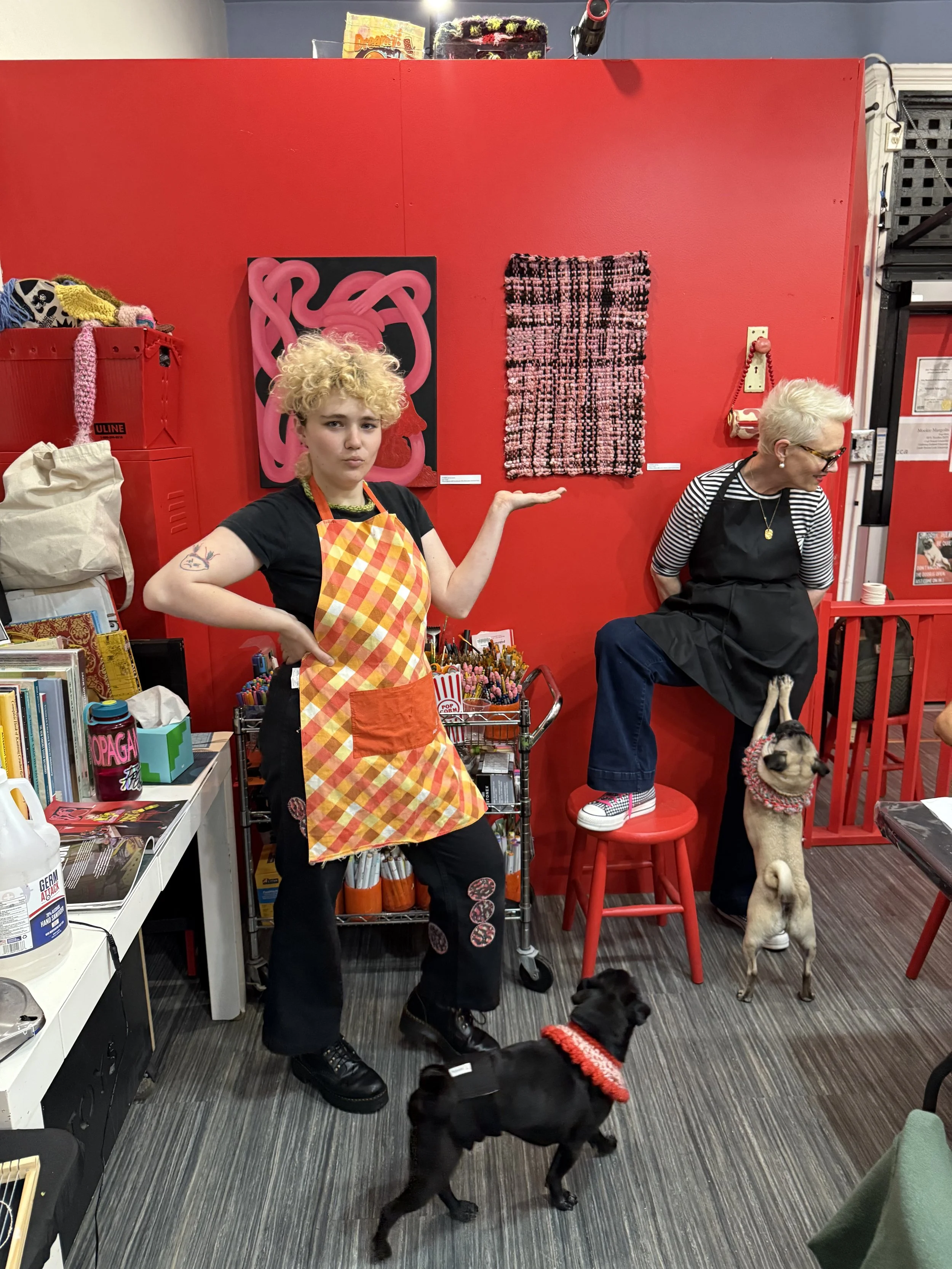
Instructors Mookie Margolis & Chris Babcock with emotional support pugs!
Custom After-School Art Studio: PAINTING, WEAVING, SCULPTURE, DRAWING
We are a nonprofit art studio for youth, dedicated to fostering creativity and growth. We prioritize emotional and psychological safety and overall well‑being in every class. We teach drawing, painting, weaving and sculpture to kids in a supportive, playful environment. Students are encouraged to choose their own imagery or develop their own creative ideas and are guided to learn how to develop both technique and creativity. We aim to give your child a creative space where they choose what to make, learn real drawing and painting skills, and feel safe, supported, and seen.
At Chris Babcock Art Prep, our nonprofit art studio helps kids discover their artistic voice through after-school classes, week-long summer camps, and short special workshops. We teach drawing and painting with patient, experienced instructors who meet each child where they are — whether they’re picking up a pencil for the first time or polishing a portfolio piece. We encourage our students to develop a lifelong practice of art: the arc of practice is about learning how to slow down and enjoy your wizard brain! To do this you have to tell you lizard brain to take a nice little nap!
Why families love us
Child-led creativity: Students select their own imagery so projects reflect their interests and grow their confidence.
Skill-based instruction: We teach techniques step-by-step, so kids learn to translate what they see and imagine into strong, expressive work.
Emotional safety first: Our programs prioritize psychological and emotional well-being — welcoming studio culture, clear boundaries, and gentle feedback create a space where kids can take creative risks.
Flexible options: After-school classes for regular practice, immersive week-long summer camps, and 1–5 day workshops for busy schedules or special themes.
Nonprofit mission: Every class supports our commitment to accessible art education for youth.
What kids gain
Better drawing and painting skills
Stronger self-expression and confidence
Focus, patience, and creative problem-solving
Real artwork they’re proud to show
Enroll now to give your child a joyful, skill-building art experience where their ideas matter. Space is limited—reserve a spot for after-school classes, summer camp, or a short workshop today and watch their creativity bloom!
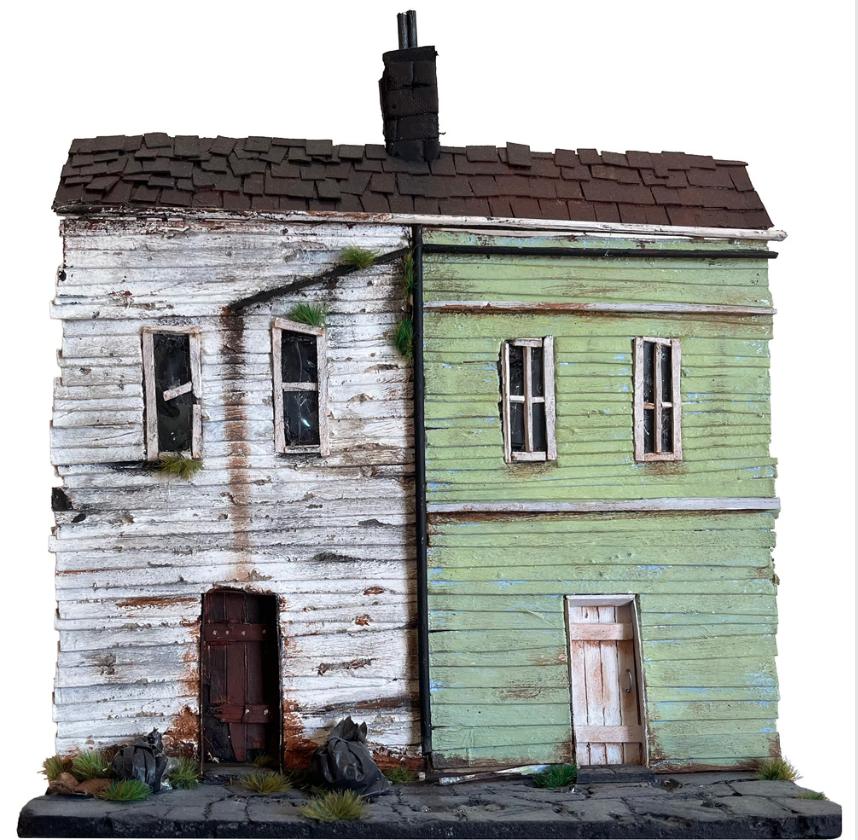
Unloved or Loved?
Kester, Age 15
Model | Scrap wood, cereal box card, old polystyrene foam packaging, and acrylic paint | 210(w) 280(h) 70(d) mm
This piece initially invites the viewer to choose their favourite building; do you see beauty in dilapidation or preservation? It also asks: can you really tell which house is loved the most by its owner?
I was inspired by how, much like my late Grandmother's beloved house, once-immaculate homes often follow their owners' decline into old age, contrasted with how they may have looked if they had continued to be maintained.
Ages: ages 8 to 18 for weaving and sculpting, ages 8 to 18 for painting and drawing
Skill Level: Beginner, Intermediate and advanced
Length: Each session is one 1.5-hour lesson once a week for 4 weeks
Tuition covers all professional-grade materials your young artist will need to bring their creations to life. We provide a comprehensive toolkit for every discipline.
Subscription & Make-Up Policy
Weekly Class: Your subscription guarantees one class per week on your chosen day.
3-Class Months: For months with only 3 scheduled classes, we offer a complimentary make-up week.
To Reserve: To reserve your make-up date, text Chris babcock at 451-745-5301 Contact us if you need to schedule an alternative date.
Standard Make-ups: Students are allowed one make-up class per monthly session, which must be used within that session.
Make-up Day: Sundays, from 1 PM to 5:00 PM.
Need Help? Text us your child's age, and we can send you project examples that are a perfect fit.
How to Prepare for your Child’s Art Class
To ensure your young artist has a productive and inspiring experience from day one, please follow these simple steps based on their chosen discipline.
Project Preparation by Discipline
For Painting & Sculpture Projects
Please submit your child's project idea and chosen medium at least 5 days before the first class.
Text a clear image of their subject to 415-745-5301.
In the text, please specify the materials they wish to use (e.g., acrylics vs. oils for painting; cardboard, or wire paper mache sculpture).
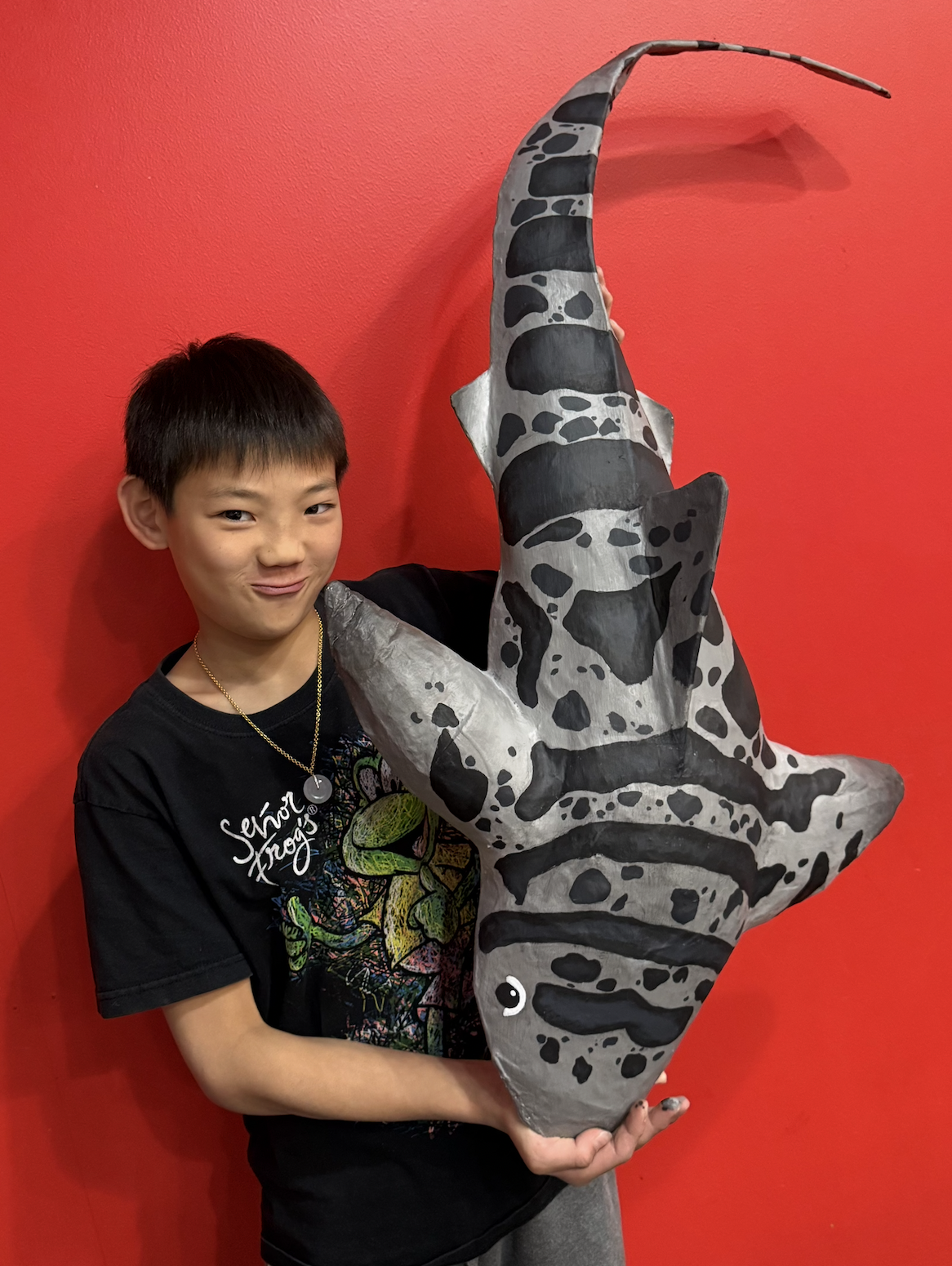
Example Ideas: A self-portrait or favorite animal (painting), or a shark made from cardboard and paper-mâché (sculpture).
For Weaving Projects
No advance preparation or supplies are needed.
Students will design their weaving project in the studio during their first class, after the instructor assesses their skill level.
For Still Life Drawing or Painting
Students are welcome to bring a small, beloved object from home to observe and create from.
Please ensure it is an object that can be safely left at the studio for the duration of the project.
Image Complexity for Drawing & Painting
For 4-Week Sessions (6.5 hours)
Choose an image with moderate detail that is challenging enough to be completed within the session.
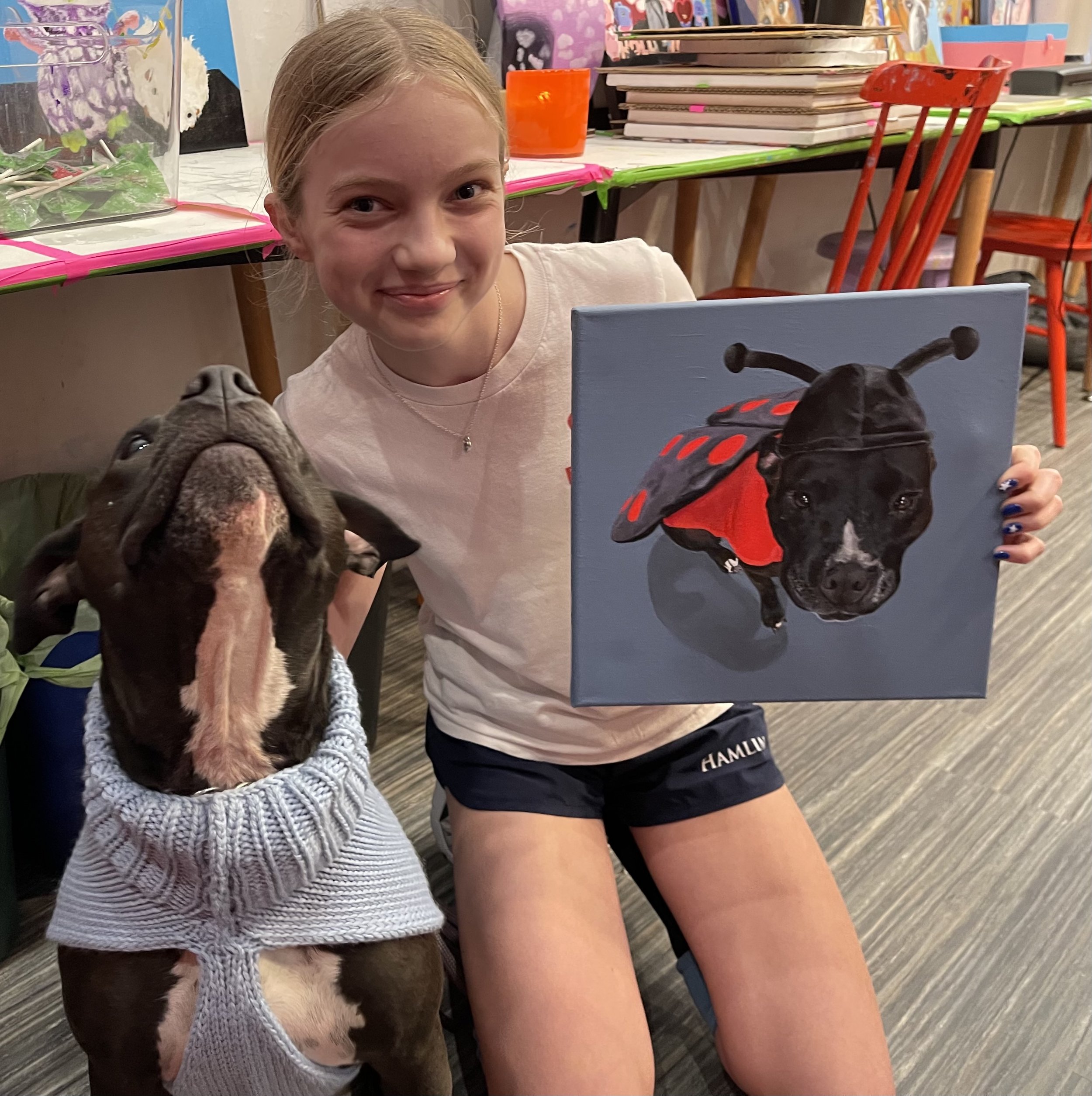
Examples: A pet's face, a detailed drawing of the student’s eyes, a favorite character.
For Year-Long Study
More complex and detailed images are highly encouraged to provide a sustained challenge and foster deeper skill development.
Studio Communication
The most direct and reliable way to reach us for all communications is by texting 415-745-5301.
Canvas Selection
Canvas Options:
Rectangle: 11x14, 9x12, or 8x10 inches
Square: 12x12 inches
Shaped: Circle. Heart, or Oval (approx. 10 inches)
Important: Please ensure your child's chosen image matches the shape of their canvas for the best artistic result.